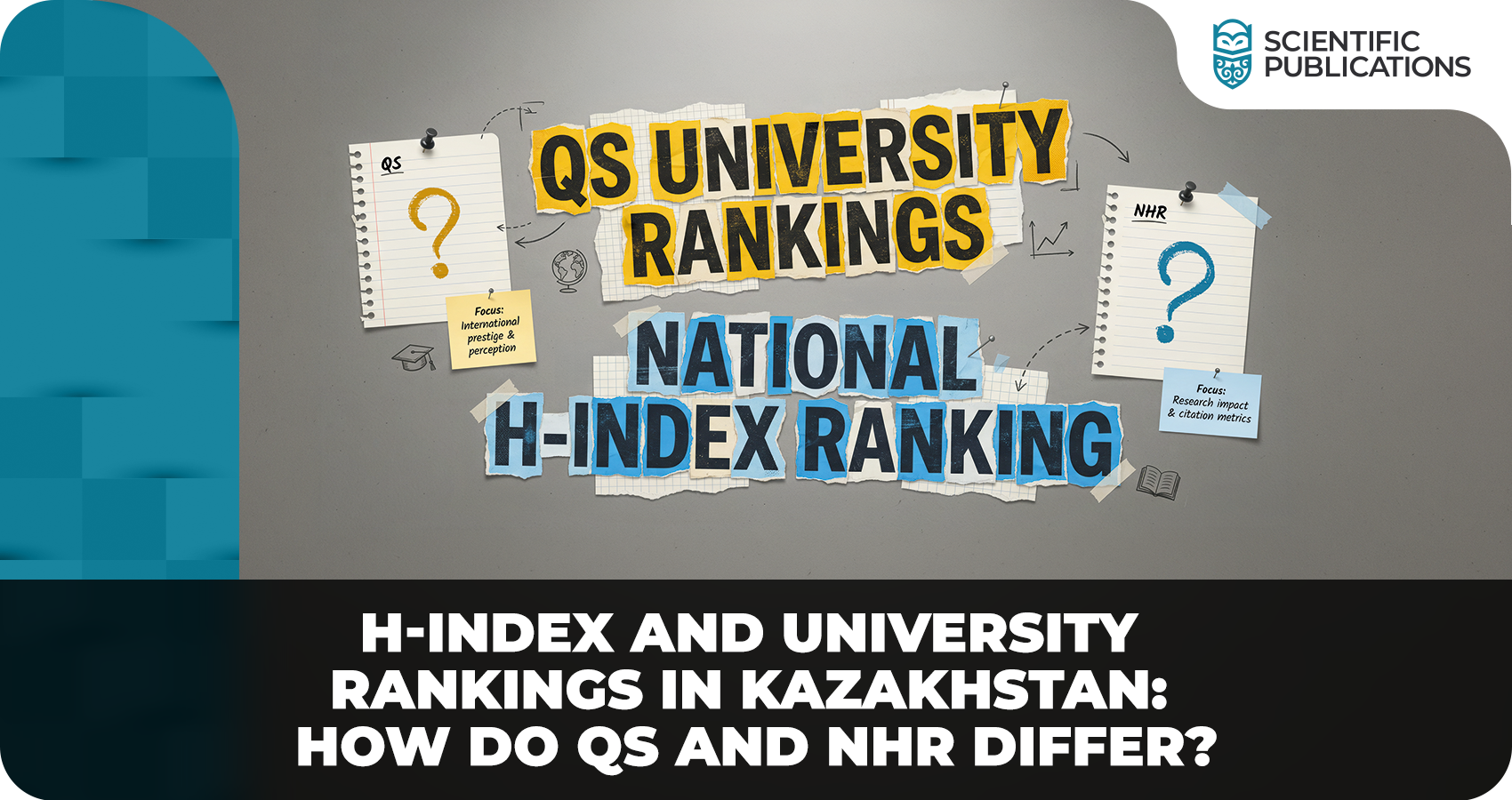
A university’s ranking positions influence its reputation, international cooperation and ability to attract students. In Kazakhstan, two rankings receive the most attention – the international QS World University Rankings and the National H-index Ranking (NHR), which assesses the scientific productivity of organisations within the country. Both rankings rely on scientometric data, yet they measure different aspects of a university’s activity and take staff publications into account in different ways.
What is a university’s h-index?
The h-index (Hirsch index) is the largest number h for which an author or organisation has h publications that have each been cited at least h times. The indicator reflects both the number of works and their citation rate.
For a university, the h-index is calculated across all publications bearing its affiliation. Values in Scopus, Web of Science and Google Scholar generally differ, as each database indexes its own set of sources.
The NHR ranking: how the h-index determines a university’s place in Kazakhstan
Kazakh National H-index Ranking is an independent ranking that assesses the scientific productivity of scientists, research groups and organisations in Kazakhstan on the basis of the h-index. According to the ranking methodology, the National H-index is calculated as the arithmetic mean of the h-index values in Scopus, Web of Science and Google Scholar, with the Google Scholar value divided by two.
The ranking is updated twice a year – based on the results of the second and fourth quarters. Organisations in the top 10% by total h-index are placed in the “Scientific potential leaders” category. According to the update for the second quarter of 2026, Nazarbayev University ranks first among universities with a National H-index of 147, followed by Al-Farabi Kazakh National University (KazNU) with a value of 104.
Which indicators does the QS university ranking consider?
The QS World University Rankings methodology remained unchanged in 2027 and includes nine indicators that contribute to the overall score:
- Academic reputation – 30%.
- Citations per faculty – 20%.
- Employer reputation – 15%.
- Faculty/student ratio – 10%.
- International faculty ratio, international student ratio, international research network, employment outcomes and sustainability – 5% each.
The h-index is not part of the overall QS ranking, but it is used in the subject rankings, QS by Subject. In the QS World University Rankings 2027, published in June 2026, Kazakhstan is represented by 18 universities, with KazNU achieving the best result among them in joint 177th place.
How the QS and NHR rankings differ for universities in Kazakhstan
The main differences between QS and the NHR relate to the purpose of each ranking and its data sources:
- scope: QS compares universities from different countries, while the NHR covers research organisations within Kazakhstan
- data sources: QS uses Scopus, global surveys and data submitted by universities themselves, while the NHR uses Scopus, Web of Science and Google Scholar
- role of the h-index: in the NHR, position is determined by the h-index alone, whereas the overall QS ranking does not use it
- reputation: in QS, the opinions of academics and employers account for 45% of the overall score, while the NHR does not conduct surveys
- frequency: the QS World University Rankings are published once a year, while the NHR is updated twice a year
The difference in approaches can be seen in the example of the leading universities. Nazarbayev University consistently tops the NHR, whereas in the QS Asia University Rankings 2027 it is placed 139th, and the best result among Kazakhstani universities belongs to KazNU in 46th place.
How does a scientist’s h-index affect a university’s ranking?
An organisation’s indicators are made up of its staff’s publications, so every cited article with a correct affiliation contributes to the university’s position. In the NHR, this link is direct through the h-index, while in QS it works through citations per faculty and the international research network.
It is important for scientists to state their affiliation consistently in English and to keep their profiles in Scopus, Web of Science, Google Scholar and ORCID up to date. Errors in the organisation’s name may result in some publications not being counted towards the university’s indicators.
The QS and NHR rankings complement each other: QS assesses a university comprehensively, while the NHR reflects its accumulated scientific potential through the h-index. Regular publications in indexed journals and properly maintained scientist profiles help strengthen a university’s position in both rankings.
Need help with publishing a research article? The specialists at Scientific Publications will help you choose a journal indexed in Scopus or Web of Science and support you at every stage of the publication process. To receive a free consultation, fill in the form below and our manager will contact you shortly. Onwards to new scientific achievements!