An international internship allows a lecturer to work in a foreign scientific environment rather than only become familiar with it through publications. For future articles, this may mean access to databases and equipment, discussion of methodology with colleagues and the search for co-authors. Below, we look at the opportunities for publications and the participation conditions in Kazakhstan.
How does an international internship affect a lecturer’s publications?
An internship does not in itself guarantee a publication, but it can change the conditions in which work on an article is carried out.
An analysis of publications by 60 scientific organisations from different regions over 2014-2023 showed that articles with international co-authorship were, on average, cited more often than works with national, institutional or single authorship. The authors note that such co-authorship often arises from academic mobility, but they measured citation rates, not the quality of articles.
During an international internship, a lecturer can:
- gain access to the databases, libraries and equipment of the host organisation
- discuss methodology and a draft article with foreign colleagues before submission to a journal
- become familiar with the editorial requirements of international journals
- find potential co-authors for joint publications
International internship programmes for lecturers in Kazakhstan
The selection and completion of scientific internships are governed by “Rules for the selection of applicants and the completion of scientific internships”, approved by order No. 422 of 18 August 2023.
An internship lasts from 3 to 12 months and takes place at a foreign organisation from an approved list. When the list is compiled, the organisation’s place in international rankings is taken into account: for universities, the top 100 places in the QS rankings by subject; for research centres, the top 1,000 places in the SCImago Institutions Rankings.
Accommodation, meals, the purchase of scientific literature, travel, a visa and medical insurance are funded from the republican budget. Following the internship, a mandatory period of work with the employer of at least three years is provided for.
The deadlines for submitting documents are approved annually. The categories of employees eligible for internships under the “Bolashak” programme are also determined for each year: in 2026, they included teachers at all levels of education.
Which publications are required for a lecturer’s international internship?
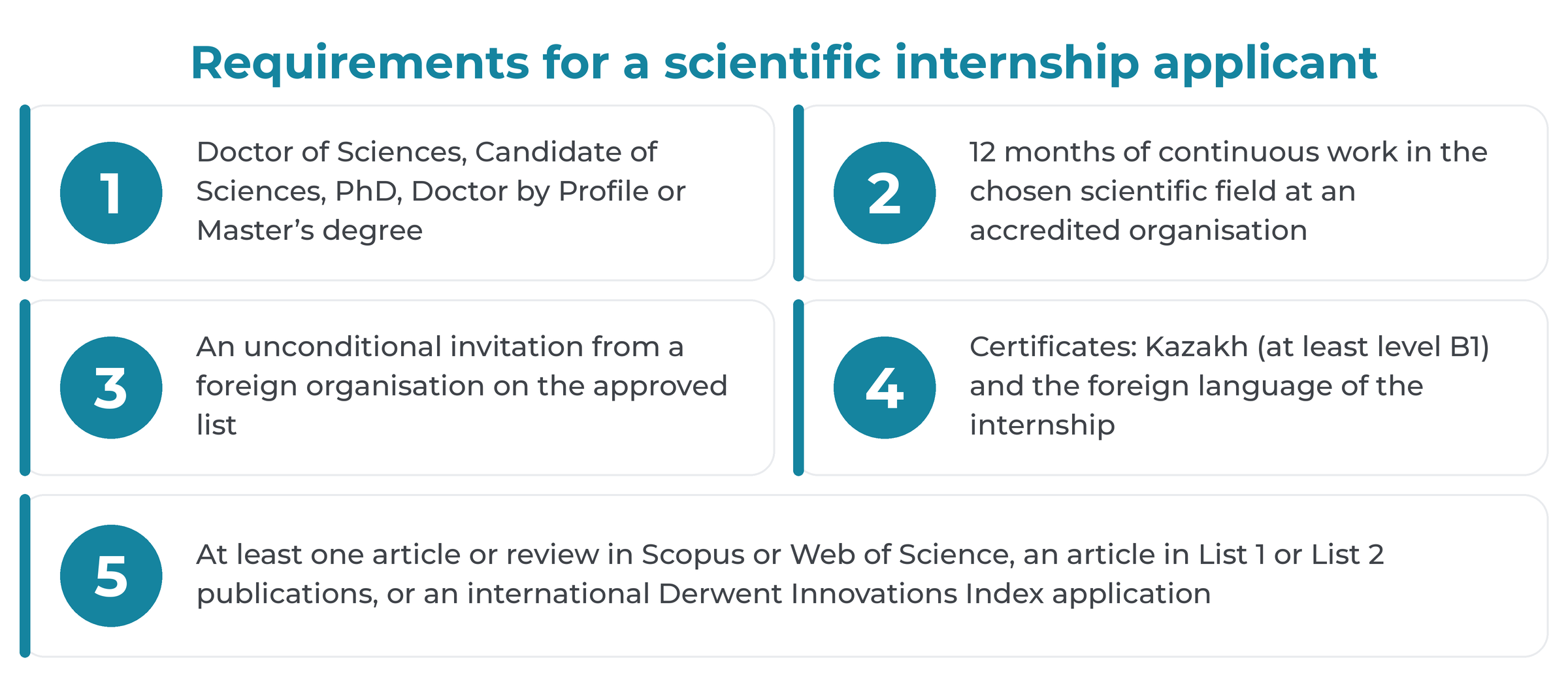
Publication activity matters even at the document submission stage. An applicant for a scientific internship is a research employee of a scientific organisation or university, and, according to the Rules, the requirements include:
It is advisable to check a journal before submitting an article: if the journal’s indexing in Scopus or Web of Science has been discontinued because of violations, all of the applicant’s articles in that journal are not taken into account.
Planning future publications during a lecturer’s international internship
According to the Rules, the scientific internship programme includes modules on research methods, access to libraries, planning of scientific work, analysis of research and formulation of conclusions, as well as academic writing.
For future publications, it is useful to decide in advance on the topic of the article, the distribution of roles among co-authors and how the affiliation with the host organisation will be stated.
Peer review of an article may take several months, so part of the work is often completed after the return to Kazakhstan.
An international internship can expand a lecturer’s opportunities for future publications: access to resources, discussion of work with colleagues and international co-authorship. Participation in the competition requires a publication that meets the requirements of the Rules, so it is advisable to start work on articles before submitting the documents.
Need help with publishing a scientific article? The specialists at Scientific Publications will help you check a journal’s status and select a suitable one, and will support you at every stage of the publication process. To receive a free consultation, fill in the form below, and our manager will get in touch with you shortly. Onwards to new scientific achievements!